
Neeme Järvi Looks Ahead
At 73, Neeme Järvi is still “kicking my shoes off and putting them
on again.
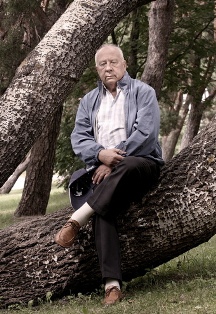
“I have a huge amount of guest conducting. My calendar is completely full.”
But not necessarily with dates in the United States, he said at
Estonia’s Leigo Lake Music Festival in August.
Although Järvi is a U.S. citizen and makes his home in New York
City, “I am changing my workplace,” he said. This includes a re-commitment to his native
Estonia, which he left in 1980 to seek artistic freedom in the West (Estonia
was under Soviet domination at the time).
This month he becomes music
director of the Estonian National Symphony Orchestra, resuming the post he
first held in 1960. His opening concert,
Sept. 9 in Tallinn, will feature Estonian composer Arvo Pärt’s Third Symphony
in observance of his 75th birthday. Pärt
dedicated the symphony to Järvi, who premiered it in 1971 with the Estonian
National Orchestra.
Järvi spent 20 productive years in the U.S., first as music
director of the Detroit Symphony (1989-2005, then the New Jersey Symphony (2005-2009). “Detroit is over. New Jersey is over. But also I feel that America is not very much
interested in my activities there,” he said.
A proven orchestra builder and master of a huge repertoire, Järvi
is disturbed by the direction American orchestras are taking.
“American orchestras are making very strange decisions which
absolutely don’t look professional. It
seems to me that they are leaving decisions up to people who don’t know about
music. It happens now with the big
orchestras. It’s about money, (the)
economy, but they are not interested in quality, and I feel it’s not fair to be
in this environment.
“(Of) the appointments I see now, only (Gustavo) Dudamel is a
quality person. Los Angeles did the
right thing. I see it different in other
places, but I am not going to criticize.
It very much depends on the board of directors, management, money.”
Järvi is particularly distressed about the Detroit Symphony. “It’s painful to see. With a very well known conductor (Leonard
Slatkin, music director since 2008) I thought there was going to be a big
change for the better. One of the
greatest American orchestras where Glazunov, Rachmaninoff and Richard Strauss
conducted and Gabrilowitsch built a wonderful concert hall, everything is
there. And now they are trying to make
the orchestra smaller. They are not well
managed and it goes down and down.”
Järvi nevertheless remains a steadfast admirer of U.S. orchestras. “The U.S. is a great country and there are
still a lot of musicians and a lot of great bands and orchestras and youth
orchestras. American orchestras (and
English and Scottish orchestras) are very quick. They have to get results the next day. You have to be ready. The quality which American (and London)
orchestras give is the best to my knowledge.”
But again, “it varies from state to state,” he said.
One of Jarvi’s frustrations is with the media. “They are not even doing reviews of symphony
concerts. I like to know what’s going on
in the United States.” The drift of the
American media also disturbs him. “They
are already trying to find problems with Dudamel. You know, ‘the Los Angeles Philharmonic didn’t
play so well in Philadelphia,’ oy, oy, oy.
The main thing is competition, competition. That’s America.”
[That said, Järvi does have
a return engagement with the New Jersey Symphony in January, 2011, and he will
guest conduct the National Symphony Orchestra at the Kennedy Center in
Washington in May.]
Järvi is concentrating now on recordings and working with his old
orchestras, like Sweden’s Gothenburg Symphony and the Royal Scottish National
Orchestra (which he served as principal conductor from 1982-2004 and 1984-88,
respectively). He remains music director
(since 2005) of the Residentie Orchestra of The Hague in The Netherlands and tours
and records with it as well.
Recordings upcoming include orchestral works by Norwegian composers
Johann Halvorsen and Johann Svendsen with the Bergen Philharmonic, and he is
completing a cycle of suites from four Wagner operas arranged by Henk de
Vlieger with the Royal Scottish National Orchestra (both projects for Chandos).
Järvi will conduct the
Orchestra of the Accademia Nazionale di Santa Cecilia in Pärt’s “Cecilia,
vergine romana” for the Pope in Rome in October. During the 2010-11 season, he will guest conduct
the London Philharmonic (a recording of Dvorak’s Stabat Mater is in the works),
also the Berlin Philharmonic, the Leipzig Gewandhaus Orchestra and the Vienna
Symphony, among others. “I have a lot of
scores to carry from one place to another,” he said.
This is not unusual for Järvi, whose web site (www.neemejarvi.ee) emphatically
declares: “I love all the time, every
day, from morning till evening, I love music.”
Of his busy schedule, he said, “It always has been like this. I try to change my life style a little bit,
but it seems it is more full than it was before.” (He said that 100 concerts a year was his
maximum, though “I try to do less.”)
Järvi is very gratified by two things, his conductor sons Paavo
(47) and Kristjan Järvi (38). “My heart
is smiling when they continue what I hope I injected in them from a young
age. They are very different. Not everyone can make a big deal of the
Beethoven symphonies like Paavo is doing now.
And I like very much Kristjan’s recording of the Mass by Bernstein,
Haydn ‘Paris’ symphonies and ‘Seven Seals’ oratorio by (Franz) Schmidt. He also likes jazz and is doing wonderful
performances of Arabic and Turkish music (with his electro-acoustic chamber
ensemble Absolute).”
With nearly 500 recordings to his credit -- one of the largest
discographies of any conductor -- Järvi is pleased that some of them are
receiving renewed (and sometimes belated) attention. “At the time it came out (25 years ago with
the Gothenburg Orchestra) I got worst recording of my Sibelius Sixth Symphony. Now it seems it’s in first place in “Building
a Library” (BBC Radio).”
Järvi, who said he is a “very” happy man, is delighted to be back
in Estonia. “The Baltic countries, there
is wonderful cultural life here, and I also love Scandinavia.” In the summers, he will continue his annual
master class for conductors in Estonia (in the seaside resort of Pärnu and in
Leigo in the south, near Otepää).
And it wouldn’t be Neeme Järvi if there weren’t something up his
sleeve.
He has high hopes of performing and filming (with director Jason
Starr) the closing scene of Wagner’s “Die Götterdämmerung” at Leigo. Built on a farm – to use the clichéd term “in
the middle of nowhere” – Leigo is an outdoor venue, where concerts are
performed on barges on lakes surrounded by forest. Performances are accompanied by spectacular
fire and water effects. As such, Leigo
would be a perfect locale for “Götterdämmerung,” the final opera of Wagner’s “Ring”
cycle, which concludes with the home of the gods (Valhalla) in flames and the
Rhine River overflowing its banks.
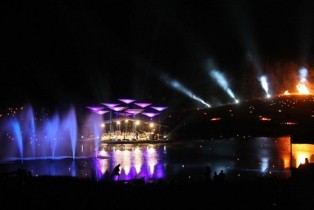
“It depends on sponsors,” Järvi said. “We would have to record it in Tallinn and
make all the water and fire in Leigo. It’s
a fantastic idea. In the last scene, you
need real water and fire and it’s only possible here.”