About Music in Cincinnati
For the classical music lover, Cincinnati is a listening post of the first order, with musical
endowments far out of proportion to its size (metropolitan area approx.
1.3 million). They include the Cincinnati Symphony Orchestra,
Cincinnati Opera, Cincinnati May Festival, Cincinnati Chamber
Orchestra, artists and ensembles of the University of Cincinnati
College-Conservatory of Music and Northern Kentucky University, Chamber
Music Cincinnati, Linton Chamber Music Series, Kentucky Symphony
Orchestra and many others. The primary purpose of
www.MusicinCincinnati.com is to try to bring that perspective to a
wider audience.
The majority of the archival material on this site (before 2008) comes from The Cincinnati Post, which ceased publication Dec. 31, 2007.
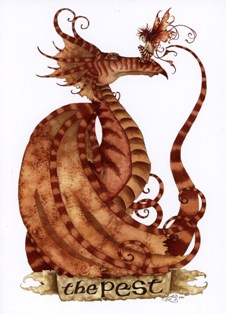
As for the role of critic, reporter, chronicler, archivist and generally passionate observer of great music (of any kind), the author feels total kinship with this winged one (the tiny one) by Amy Brown. Forgive!
The majority of the archival material on this site (before 2008) comes from The Cincinnati Post, which ceased publication Dec. 31, 2007.
"The Pest" by Amy Brown
|
About the author
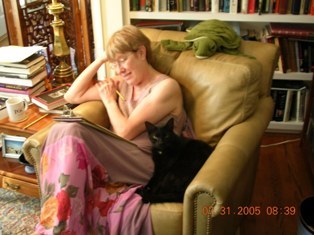
Mary Ellyn and Jett
|
She was trained as a violist at the University of Kentucky with Kenneth Wright, spent a summer at Colorado College as a student of Paul Doktor, earned a Master of Arts in music history at Yale University and a J.D. degree, also from the University of Kentucky. Performance experience was with the Lexington Philharmonic and New Haven Symphony Orchestras and in Boston, Washington D.C., Maryland, Northern New Jersey, Maine, Kentucky, Tennessee and South Texas.
A personal note
I grew up in Lexington, Kentucky as Mary Ellyn LaBach. My father was a
music teacher who used to smoke, drink beer and turn up the phonograph,
a distinct annoyance for our mother but rather impressive for my
brothers and me, who developed a strong affinity for classical music.
(Bill later played the trombone, Parker the oboe.) I have vague
memories of attending concerts as a toddler. Perhaps that’s why
Franck’s Symphony in D Minor still evokes strange feelings in me. My
older brother Bill used to beat up my dolls to Khachaturian’s “Sabre
Dance.” I remember touring the band room with my Dad and thinking the
French horn was cool. I started piano at 8, just before my parents
divorced, leaving her with us and him with the piano (no more piano
lessons, a lifetime regret).
I was an enthusiastic tomboy, played softball and climbed trees. I fell in love with music again at 10, when I discovered a 78 rpm recording of Brahms’ Fourth Symphony in our grandmother’s record cabinet (actually she preferred Xavier Cugat). One of the records was broken, so it was years before I knew how the second movement ended. In the sixth grade, the music teacher at my school, Joseph Beach, came by hawking his instruments. I asked for the violin, but he steered me to viola because no one ever chose it and he thought I was big enough. I remember the long bus rides to his house with my viola and school books (I had to transfer from one bus to another to get there for my lessons). In the eighth grade, I joined the Central Kentucky Youth Orchestra, one of the country’s best at the time, led by Marvin Rabin. We performed the finale of Sibelius’ Second Symphony at the Chicago Civic Auditorium when I was 13. During my senior year at Henry Clay High School in Lexington, we traveled to New York where we played the first movement of Schubert’s C Major Symphony (the “Great”) in Carnegie Hall. On the road in Charleston, West Virginia and Roanoke, Virginia, I was soloist in the Handel Viola Concerto.
Against my mother’s wishes, I majored in music at the University of Kentucky. I studied viola with Kenneth Wright, performed Hindemith’s “Trauermusik” with the University Orchestra and had the best music history professor ever, Almonte Howell. I spent a summer at Colorado College in Colorado Springs as a student of violist Paul Doktor, performed more Hindemith and visited Aspen, where I heard William Primrose play Milhaud and met members of the Budapest String Quartet. Somewhat presciently, I wrote my very first review for the UK newspaper, a Community Concerts performance by Eugene Ormandy and the Philadelphia Orchestra.
During my senior year, I won a Woodrow Wilson Fellowship for graduate study at Yale, where I earned a master’s degree in music history. My adviser was young, be-spectacled Claude Palisca who guided me to the rare book room at Yale to select a thesis topic (the Opus 4 Concerti Grossi of Francesco Geminiani, including a realization of the original figured bass). While in New Haven, I subbed in the New Haven Symphony under music director Frank Brieff, a fiery authoritarian in the unhallowed tradition. Guest artists included Arthur Rubenstein, the young Rostropovich and a rarity for her day (a woman!), violinist Erica Morini. I left Yale to marry John Hutton, a physician and researcher from up the turnpike in Boston. We have three children and seven grandchildren.
I have been fortunate to win journalism awards from the Associated Press, Scripps-Howard Newspapers and the Ohio, Cincinnati and Cleveland Society of Professional Journalists. I love writing about music and musicians and I consider it a privilege to bear witness to one of the highest expressions of the human spirit.
I was an enthusiastic tomboy, played softball and climbed trees. I fell in love with music again at 10, when I discovered a 78 rpm recording of Brahms’ Fourth Symphony in our grandmother’s record cabinet (actually she preferred Xavier Cugat). One of the records was broken, so it was years before I knew how the second movement ended. In the sixth grade, the music teacher at my school, Joseph Beach, came by hawking his instruments. I asked for the violin, but he steered me to viola because no one ever chose it and he thought I was big enough. I remember the long bus rides to his house with my viola and school books (I had to transfer from one bus to another to get there for my lessons). In the eighth grade, I joined the Central Kentucky Youth Orchestra, one of the country’s best at the time, led by Marvin Rabin. We performed the finale of Sibelius’ Second Symphony at the Chicago Civic Auditorium when I was 13. During my senior year at Henry Clay High School in Lexington, we traveled to New York where we played the first movement of Schubert’s C Major Symphony (the “Great”) in Carnegie Hall. On the road in Charleston, West Virginia and Roanoke, Virginia, I was soloist in the Handel Viola Concerto.
Against my mother’s wishes, I majored in music at the University of Kentucky. I studied viola with Kenneth Wright, performed Hindemith’s “Trauermusik” with the University Orchestra and had the best music history professor ever, Almonte Howell. I spent a summer at Colorado College in Colorado Springs as a student of violist Paul Doktor, performed more Hindemith and visited Aspen, where I heard William Primrose play Milhaud and met members of the Budapest String Quartet. Somewhat presciently, I wrote my very first review for the UK newspaper, a Community Concerts performance by Eugene Ormandy and the Philadelphia Orchestra.
During my senior year, I won a Woodrow Wilson Fellowship for graduate study at Yale, where I earned a master’s degree in music history. My adviser was young, be-spectacled Claude Palisca who guided me to the rare book room at Yale to select a thesis topic (the Opus 4 Concerti Grossi of Francesco Geminiani, including a realization of the original figured bass). While in New Haven, I subbed in the New Haven Symphony under music director Frank Brieff, a fiery authoritarian in the unhallowed tradition. Guest artists included Arthur Rubenstein, the young Rostropovich and a rarity for her day (a woman!), violinist Erica Morini. I left Yale to marry John Hutton, a physician and researcher from up the turnpike in Boston. We have three children and seven grandchildren.
I have been fortunate to win journalism awards from the Associated Press, Scripps-Howard Newspapers and the Ohio, Cincinnati and Cleveland Society of Professional Journalists. I love writing about music and musicians and I consider it a privilege to bear witness to one of the highest expressions of the human spirit.