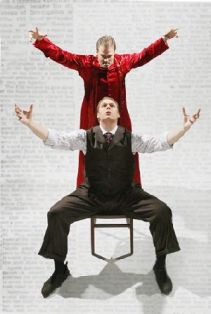
Baritone Jonathan Lasch as Shrike (in red) and tenor Daniel Paget as Miss Lonelyhearts in Lowell Liebermann's "Miss Lonelyhearts" at the University of Cincinnati College-Conservatory of Music
|
Lowell Liebermann’s “Miss Lonelyhearts” might be called “The Passion of Miss Lonelyhearts.”
The 2006 opera, given its Midwest premiere by the opera department of the University of Cincinnati College-Conservatory of Music Feb. 6, 8 and 10 at Corbett Auditorium, takes Nathanael West’s 1933 novella beyond “dark comedy” into the tragic.
It’s there in Liebermann’s music, which deliberately evokes the Passion settings of Bach, in librettist J.D. McClatchy’s dramatic adaptation of West’s 58-page text and in the production directed by Ken Cazan, resident stage director for the Thornton School of Music at the University of Southern California in Los Angeles.
Commissioned by New York’s Juilliard School of Music for its 2006 centennial, the opera was produced in collaboration with USC’s Thornton School and CCM, giving the work exposure in three different parts of the U.S.
It’s a good thing, too, for “Miss Lonelyhearts,” somewhat like “Jerry Springer: the Opera,” is guaranteed to offend just about everybody. (CCM included adult advisories in its promo material for the opera and there was a warning outside Corbett Auditorium about gunshots in the production.)
Conceived as a kind of Depression-era allegory on the futility of the American Dream, West’s remarkably up to date story centers on a reporter for a big city newspaper writing an advice column under the byline “Miss Lonelyhearts” (“her” photo shows a stylish woman, faced half covered with a broad-brimmed hat).
Created in fun to increase circulation – how familiar is this in today’s cynical media world? – the column has taken its toll on the writer (who remains unnamed). Letters pour in to Miss L, all replete with inexplicable suffering. The wear and tear – “how to answer?” -- has unhinged him. In contrast to earlier (softened) film versions of West’s story, McClatchy and Liebermann have made it more operatic by fulfilling its implications and giving Miss L a full blown “Christ complex.”
Miss L fights a losing battle against despair, seeking refuge in alcohol, sex, even life in the country with his clueless fiancée Betty. Nothing works, especially with his malignant editor Shrike (read Satan) and a newsroom of bestial journalists relentlessly taunting him.
The tragedy is consummated by having Betty abandon Miss L (in the book they reconcile as he agrees to quit his job and find one in advertising). And it is no slip of the wrist when Peter Doyle, the vengeful husband of one of his readers, shoots him at the end. (Miss L’s last words to his killer are “I love you.”)
A professional company, with box office and donors to please, would hesitate to risk such a daring production. (In fact, according to July’s Chronicle of Higher Education, there were students who balked at participating in it.) For within “Miss Lonelyhearts” is a Pandora’s box of offensive content: physical violence (including a gay-bashing barroom brawl), explicit sex (all kinds, including masturbation), foul language, racial, ethnic, religious and sexist bigotry and the delicate subject of religion itself, seen here as an opiate for suffering as well as Miss L’s refuge and self-justification.
The production’s multi-media staging provides swift, deep immersion in the story. Three elevated scrims accommodate a stream of video images and serve as screens behind which Miss L’s correspondents appear when excerpts from their letters are read. Furniture and set pieces roll on and offstage below.
The opera begins with a sensational image, Miss L tapping on his typewriter as a red-robed cardinal prays to him from behind and sprinkles him with holy water. (There is no denominational bias, as Shrike emulates an evangelical preacher later in the opera.)
Scenes transpire in a chaotic newsroom, a speakeasy, Miss L’s bedroom, apartments in the city and a house in the country. A cloud of “ghosts” – the suffering writers of letters to Miss L – hover on the outskirts at all times. Miss L’s increasing obsession with Jesus is visible in his room, where a figure of the crucified Christ grows from miniscule to more than life-sized in the final scene.
Liebermann, an American neo-romantic, has written a lushly eclectic score that illuminates the text wonderfully. There are allusions to jazz, honky tonk, Broadway, nursery tunes, pop songs, even Tchaikovsky’s “1812” Overture. There is a gorgeous “Escape” duet/trio, where Betty and Miss L are joined by Shrike over lush strings and harp, and the music accompanying Miss L’s stay in the country with Betty is filled with calm and beauty.
While many of the opera’s jokes are not funny, there is a scene in which Miss L seduces Shrike’s wife Mary as she carries on a hilarious coloratura “conversation” with him to (supposedly) fool her husband in the next room. By contrast, during the brawl in Delehanty's speakeasy when the reporters gang up on an old man, bedeviling the "old fag" to tell them "his story," the orchestra quotes mockingly from "Life Upon the Wicked Stage" from "Show Boat."
Miss L’s duet with Amy Doyle, a writer with erotic motivations who has wrangled a meeting with him and ultimately rapes him, presents a striking dual image. Her strident, bitter complaint contrasts vividly with his slow, reassuring singing of Christ’s (and her husband and child’s) love for her.
There are several outright Bachian moments, as in Miss L’s “Crying Out to Thee, O Lord” with English horn and oboe accompaniment over pizzicato strings and following the Gethsemane-like scene where he is tempted mercilessly by Shrike and the other reporters, his final paean to divine love, bathed in white light and cellos.
The cast was headed by tenor/3003 CCM alumnus Daniel Paget as Miss L, a sympathetic figure with a ringing voice and considerable dramatic flair. Shrike was a devilish, leering Jonathan Lasch (baritone), with tenor Daniel Maimone poignant and credible as the duped, crippled Doyle. Mezzo-soprano Andrea Helm chewed up her role as his vicious wife Amy, complete with Brooklyn accent. Soprano Heather Phillips in prim suit and pillbox hat was suitably vacuous as Betty, whose mantra “Are you all right?” collides pitifully with Miss L’s plight. Soprano Sonia Rodriguez Bermejo’s provocative Mary had the juice vocally and physically.
The orchestra, accomplished and alert under Mark Gibson, director of orchestra studies at CCM, showed considerable mettle in the pit.
With this venture, CCM continues its fine tradition of edgy, non-traditional works. If “Miss Lonelyhearts” was too strong for some patrons (and there were some defectors after the first act), they will have Puccini’s “La Boheme” for relief May 15-18 at Corbett Auditorium.